This post is sponsored by:

Showing posts with label ebooks. Show all posts

Sunday, March 20, 2011

eBooks and eReaders: The School Library Solution

Remember going to the library as a kid?  I was never a big reader but I liked the library.  It was a powerful place to step into to.  Granted I love a Google search, but I still like sifting through books for answers or delving into a good story that launches me onto an amazing adventure.  Libraries in schools and in communities are very important places.  They make books accessible to students and communities.  Something we often take for granted, but shouldn't.  There are many places in this world that still limit what is accessible to people.  

Libraries face a lot of barriers in terms of keeping a selection available.  Budgets don't always allow for space to house the books, replacing worn out copies, providing multiple copies, so forth and so on.  eBooks and eReaders are opening up amazing new avenues to break many of those barriers down.  Schools are starting to see this, but unfortunately a model of what that really looks like is not always available right now.  It's more like a puzzle where all the pieces are there . . . we just need to put the puzzle together.  Some schools are approaching this in great ways though and libraries are the best place to start.  The best approach in my opinion is  . . . "Lend the library" by lending preloaded ereaders. It's actually pretty simple to do today with huge advantages.  Let's take a look:
    • Create "blocks" of 6 ereaders to an account
    • Use a generic designated email address for each "block" of 6 which will serve as the username on the service
    • Purchase ebooks on one and "sync" to the rest easily or simply sign onto the account for each "block" and make the purchase online and "sync" out to each device.
    • "Syncing" doesn't require hooking up to a computer either.  It's done right over the air using a WiFi connection.
  • Security and required credit cards are protected by enabling purchase password protection.  In fact, the credit card information is not accessible at all on the ereaders themselves.
  • Lending and tracking devices can be easily done through the serial numbers on the devices.
  • Access to even more books is expanded a great deal.  There are tons of 'public domain' ebooks which are often free.  PDF versions of ebooks can be manually loaded on to the ereaders.  So forth and so on.  
  • Students do not have to worry about internet access at home.  Once the ebooks are downloaded, they are on the device and do not require a signal to read them.  
  • eBooks don't wear out.  Yes, ereaders can break but since backups are always kept through companies like Barnes and Noble, once you replace the ereader and sign onto the account . . . all the ebooks come right back.  (Any manually loaded PDF's would have to be manually put back on which is often simple enough to do).
  • Schools could also create designated sets of ereaders for professional development books for educators to borrow using the same methods.  
  • Students can customize the text with resizeable text.  Students with vision impairments that need larger print . . . they got it in every ebook.
  • Libraries get more for less.  Even with the classics any library would be hard-pressed to find 6 exact copies of any title for free.  In the ebook world they can find pretty much every classic and easily get 6 copies exactly the same for free.  When it comes to regular books, the savings is huge and here's why:
    • We'll use a popular Young Reader's author, Mike Lupica, and his title "Travelling Team".  
    • As a paperback (which often wear out much quicker) the cost would be about $7.91 for each copy.  If you purchased 12, that would equal $94.92
    • As an ebook with 2 "blocks" of 6 ereaders, you purchase 2 copies at $6.99 each which becomes 12 copies.  So your total cost now for 12 copies of that title is $13.98 for a savings of $80.94.  And that's just one title.  
Note I didn't speak to textbooks here.  eTextbooks for schools really isn't there yet.  It's an entirely different publishing world and the books are much more complex to create the best educational reading experience.  eInk style ereaders can not accomodate these type of publications adequately.  Emerging tablets will be the way to go eventually with textbooks in my opinion.  

These are exciting new avenues, but they are difficult for many to "see" because they are vastly different from what we are used to.  Packaging up a library of books and lending that out to someone has never been a rational thought before.  In the ebook and ereader world it is possible and with huge benefits.  Buying one book and getting 5 additional copies never existed.  Now it does.  A library suffering physical damage that destroys the books is extremely difficult to rebuild and restock.  An ereader that is damaged and replaced can easily have all the books back on it in a matter of minutes by simply signing back onto the account.  Now if someone could just make that car that folds up into a briefcase like the Jetsons . . . 

What are your questions or thoughts?

Saturday, March 12, 2011

Why eBooks Matter: Opening Up New Opportunities For Authors and Groups

eBooks are a big focus and there are a ton of positives going on.  eBooks not only provide great advantages for individual readers and authors, they are opening up a variety of new avenues for new business models and new revenue opportunities for groups like non-profit organizations.  Let's take a look at some of the differences in print publishing and ebook publishing and how you can capitalize on the ebook opportunity.

Distribution Made Easy


In the print publishing world there is often several "hands" involved.  The publisher, the distributor, and the bookseller all have a role and each get a percentage of the sale.  Since costs of warehousing, shipping, and returnability agreements can be significant; getting a book on shelves in a store can be difficult for new or one-time authors/groups. This process can be lengthy as well sometimes taking months.

In the ebook world, costs are minimal.  Therefore companies selling ebooks can provide services which allow you to upload your ebook and make it available for readers to download.  The time from upload to being available for purchase is reduced to hours.  The quoted average turn around times is about 72 hours which can be less.  When I recently uploaded my ebook, "The Connected Church: A Tech Guide For Church Leaders and Parishioners", to Barnes and Noble's Pubit the ebook was available within 24 hours.  It was less than 48 hours with Amazon's Kindle Direct.

Reaching More Readers In One Shot

As most authors will tell you, there is always the tough job of bustling around to get their book on shelves within stores and trying to get books sold.  This is often contained to local booksellers.  In the ebook world, readers have access to the book where ever they are.  Once the ebook is uploaded readers using ereaders or ereader apps can easily find and download your ebook to their device of choice (i.e. PC/Mac, iPad/Tablet, iPhone, Android phone, Blackberry, etc.).  Rather than spending large amounts of time getting the book on shelves, you can focus more time on telling people your ebook is available.

With ereaders and ereader apps on mobiles devices, readers are carrying entire book distribution systems and book stores right in their hand.  Readers can easily find books, make a decision to buy, and download direct to the device.  Within minutes they are reading the book.

Self Publishing Without the Costs


Even with more self-publishing print options available today such as print-on-demand through companies like iUniverse or Xlibris, there are still upfront costs and no guarantees that the book will actually hit the shelves in stores.  Due to distribution costs there are often low percentage payouts which requires a large number of sales just to break even.

In the ebook world there is no upfront costs.  Pubit!, Kindle Direct, Smashwords, etc. are free services.  In addition the author sets the price and can provide the book at the price they feel is appropriate.  Payouts percentages within this model average 65% to 70% to the author/publisher which are unheard of rates in the publishing and bookselling worlds.  Let's look at an example as a possibility and do the math:

$2.99 ebook x 65% = $1.94 per sale.  1,000 ebooks sold x $1.94 = $1,940

Opening Up New Opportunities


This is where it takes a little thinking "out of box" to see some amazing new opportunities for not only individuals, but also groups.  Let's take the most common example, the group cookbook.  Churches and other groups such as Flagler County's Friends of the Library have produced cookbooks in print.   They could take that same book and publish it as an ebook offering great new opportunities to reach more buyers without cost and higher payout possibilities.  This same concept can be applied to Churches creating a collection of faith stories from members of their community.  Schools and educators could use this new avenue as an educational and fundraising opportunity by creating a book as a class/school project.  Students can write and publish their own books as a project for class.  The possibilities are real and seemingless endless right now.

Book publishing then . . .


Book publishing now . . .


Wednesday, January 19, 2011

The Future of Book Stores: It's Still About The Books

"...great books are weighed and measured by their style and matter and not by the trimmings and shadings of their grammer." - Mark Twain, a Biography

Last weekend I had the great opportunity to speak to the Ancient City Writers (a chapter of the Florida Writers Association) in regards to eBooks  and the opportunities this format opens up for them.  There are a great deal of barriers that ebooks breaks down for readers, publishers, and authors alike.  Just a few are:
  1. Readers have access to more titles than ever before and can get them on demand.
  2. The customizable reading experience such as changing text size gives visually challenged readers access to the same titles at the same price.
  3. Publishers are able to reach new readers and the opportunities are wide open to enhance books with things like embedded video and animation in childrens books
  4. Authors can now enjoy new publishing options with lower cost and no distribution barriers thorugh popular new services like Barnes and Noble's Pubit!

As eBooks grow in popularity and become more of a focus as a format, I constantly get the question concerning the future of book stores themselves.  The bottom-line is that book stores will continue to be around for a long time to come.  There are some things to keep in mind when it comes to ebooks that is often getting missed by consumers and industry speculators.
  1. eBooks are simply another format of the book itself.  Just as paperbacks or audio versions are another format.  Both of which when they came out were thought to be the future demise of the industry.  Sound familiar?
  2. eBooks currently comprise less than 10% of the billions spent on books today.  Studies show that at current growth rates, ebooks will most likely meet the demand for print books within the next 5 years.  Amazon's recent announcement that Kindle Books out sold print books with them was pretty much expected.  If you are a mail-order business that offers digital downloads, of course the digital download would exceed your hard-copy mail order business. 
  3. Book stores have been evolving over the last 25 years a great deal (i.e. cafe's, expanded product lines such as gift and accessories, and now digital products such as ereaders).  Companies that embrace change and continue to evolve, will do fine in the years to come.  
In all honesty, it is actually a very exciting time within the industry as ebook popularity to grows.  There are a ton of barriers for readers, book stores, and authors alike when it comes to print books.  eBooks offer great solutions to overcome many of those barriers for all three as mentioned above.
    Book stores are seeing a great deal of change today that is even more exciting.  The print-on-demand publishing model has become more and more popular over the last several years.  This option for authors offers a lower cost option to get their book published but does not guarantee the book would find it's way on to store shelves.  Often times, the book is order only reducing the possibility of sales.  Book Espresso Machines are beginning to pop up in chains and indie book stores throughout the country.  These machines bring the term "print on demand" to a literal sense.  When the customer requests the book, it is printed and bound within minutes for them to purchase.   Again, a much lower cost distribution system for the industry with great benefits for the consumer.

    It's going to be very interesting to see what comes from the book selling and publishing worlds in the next several years.  Just click here to check out some really cool publishing examples for children's digital books.

    Saturday, December 4, 2010

    My Christmas Book Suggestions

    This is one of my favorite times of year.  Since I was a kid it's always been a time of fun, magic, and possibilities.  There is a great deal of history and wonderful stories that make up what Christmas is today, but they are often over-looked.  Then there are years where life had gotten to be too much and it was tough to get 'in the spirit' of the season.  Some of these books really gave me a real eye-opening experience during those times.  So here's some of my top Christmas book picks:

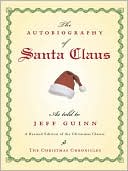
    The Autobiography of Santa Claus (Click here for the ebook)

    The first time I saw this title, I couldn't help but open it and check it out.  Jeff Guinn blends actual history of the real St. Nicholas and the histories of many Christmas traditions today into a fun-filled adventure.    This is by far my favorite Christmas book and a great read for adults and young readers.


    Stories Behind The Best Loved Christmas Songs (Click here for the ebook)

    So many of the songs we sing during this time of year have amazing stories behind them.  'Silent Night' was originally written as a poem by Father Mohr in the 1800's in Austria.  Just hours before the midnight Mass at St. Nicholas Church, Father Mohr discovered that the organ was broken and would not play.  Repair efforts were futile and he refused to have such an important Mass without beautiful music.  He remembered a poem he wrote and quickly took it to Franz Gruber to put the poem to music for the choir.  'Silent Night' was born as one of the most widely recorded and sung songs of all times.  And that is just one of the many amazing stories behind the music of Christmas in this book.

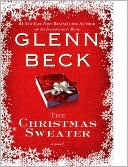
    The Christmas Sweater (Click here for the ebook)

    Glenn Beck offers this wonderful tale that reminds us of the truly important things at Christmas.  Twelve year old Eddie wants nothing more than a bike for Christmas.  He and his Mother had lost his Father years before leaving his Mother struggling to provide.  But Christmas was important to her and her parents to spend with Eddie.  Eddie's simple gift of a sweater from his Mother was a disappointment and took him down a wildly twisting path challenging him to see the truly important things in life and Christmas.

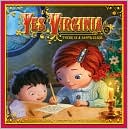
    Yes, Virginia, There Is A Santa Claus

    In 1897 8-year old Virginia O'Hanlon wrote the famous question to the editor of New York's Sun newspaper because her Papa says, 'If you see it in THE SUN it's so.'".  Francis Church was charged with responding to this very difficult question to answer especially responding to an 8 year old.  The response is timeless and was published this year as a children's picture book that is beautifully illustrated.  Click here to read the original article in New York's Sun Newspaper from 1897.

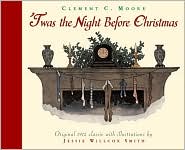
    'Twas The Night Before Christmas

    Clement C. Moore in 1822 originally wrote the famous poem to entertain his children.  A tradition of writing a Christmas poem each year that he almost forgot.  Submitted by a friend of Moore's to The Troy Sentinel, a local newspaper, the poem was published on December 23, 1823.  It has become perhaps the most popular Christmas poem ever written and the definitive source of many Christmas images today.

    What are your favorite Christmas books?

    Thursday, November 18, 2010

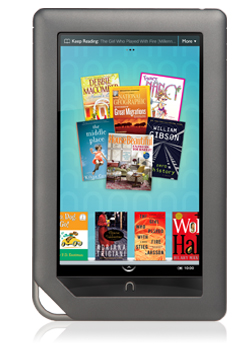
    Hands On With Barnes and Noble's Nookcolor

    Demos arrived two days ago for the Nookcolor in our store.  It was like Christmas morning for me ripping open the packaging to get my hands on the new device.  After powering it up, signing onto our account and playing around with all of the features I have only one phrase to explain it, "Very very very cool!" (sorry for the grade-school like description, but it is very fitting).

    The size and weight is very comfortable to hold and the full-color 7" touch screen display is perfect.  You can easily and comfortably hold the Nookcolor in one hand.  while using a fingerswipe to turn pages.  Setting up is simple and includes a video walk-through at startup, user manual and quick tour on the device.  Plus you can sign up for an account right on the device if you don't already have a www.BN.com account.  Then there are the other great features:
    • Change font size, margins, types and background colors within books
    • Place your books you want to access quickly right on any of the 3 'desktop' screens by dragging them and arrange them to your liking.
    • While reading touch a word and easily look up it's definition plus touch a button to get more information on Google or Wikipedia.  Or highlight a whole phrase and share it out on Facebook, Twitter, or your Gmail contacts (easy linking to these accounts in the settings). 
    • Add notes and highlights in books
    • Password protect the device itself or making purchases.  This is great for families that are concerned with kids waking purchases at will.  
    • Lending and borrowing.  This is a really cool feature.  You can designate which books to share with friends and family who can then easily see which books they can borrow from you for 14 days rather than simply waiting for you to initiate the lending.  
    • Magazines, newspapers, and kids books are in full color and have a great look and feel to them.  Kids picture books often have the read-to-me feature where a pre-recorded voice is overlayed in the book and kids can hear the words spoken to them as the follow along with the text.  
    • The web browser is very nice on the 7" screen and can be viewed in landscape or portrait.   And, yes, YouTube videos play too.
    • You can add music, .mp4 video, photos, PDF, Word documents, and Excel files for viewing.  
    • B&N's ebook (now called Nookbooks) is second to none.  With over 2 million titles that includes Google Books is an amazing selection.  And it's growing everyday.
    • And the list goes on.  
    This is already a highly talked about item and will definitely be one of the top gifts this season.  Stop by your local Barnes and Noble and check out the Nookcolor today!


    Wednesday, October 27, 2010

    Barnes & Noble Changes The eReader/eBook Game Again With Nookcolor!

    Yesterday Barnes & Noble announced it's latest eReader option with Nookcolor.  This new device is a full 7" color touch screen focused on reading ebooks, newspapers, and magazines.  Since it is a color touch screen, it adds in the ability for full web browsing capabilities.  This new option now fills the gap for those who want easy access to a vast selection of ebooks, a good reading experience, and more functionality at an affordable price ($249.00). It's available for pre-order and plans to ship on 11/19/10.


    The device is WiFi only and comes loaded with 8GB of memory that can be expanded to 32GB.  That kind of storage can hold thousands of ebooks plus photos and music.  The WiFi only was a great decision to keep the cost down and since so many wifi locations are available these days, 3G isn't always necessary. The only downfall is battery life decreases to 8 hours and is not accessible like in Nook 3G and Nook Wifi.  Then again, the battery is also not accessible in the Kindle or iPad.

    So why is this a game changer in the world of eBooks?  First of all, you have to look at the availability of ebooks themselves for a device.  Barnes and Noble provides the largest and most powerful ebook store in the industry.  By using a standard format for the ebooks (epub) and a strong relationship with publishers, they are able to offer a huge selection (over 2 million and counting) plus other sources such as Google Books (which is fed right into the B&N ebook store).  All of which can be delivered to the device without the need to hook up to a computer using the wifi signal (or the 3G signal in the Nook 3G).

    Second, the Nookcolor option fills the gap for readers that has existed between eink displays and emerging tablets while still keeping the price affordable.  Currently, consumers wanting the ability to read ebooks and also want multi-function ability are looking at devices like the iPad which starts at $499.  Nookcolor provides similar functionality at a much lower price.

    Third, the tablet format of Nookcolor also provides new options for certain books that do not work well in the eink display such as children's picture books and newsstand magazines and newspapers.  Barnes and Noble is unleashing Nookbooks (B&N's new name for ebooks) for kids which will offer thousands of interactive children's titles.  They are also releasing Nooknewsstand which will provide readers with digital versions of newspapers and magazines in full color with a rich reading experience.

    If no one has noticed (which it seems many haven't); Amazon has been playing follow-the-leader with B&N over the past year with price drops, a new wifi version of the Kindle, and now a lending feature.  Amazon's biggest barrier is its insistence on using their own unique file format for ebooks (Kindle Books) and the blocking of the epub format which keeps their selection at a fraction of what B&N offers.  So the release of Nookcolor will definitely be interesting to see what Amazon does.  Likewise, B&N also announced that Nooks will now be the exclusive ereader devices sold in Books-a-Million's 229 stores as well as Best Buy and Wal-Mart.

    Friday, October 8, 2010

    Book Publishing Made Anew: Pubit!

    Most people in the book world will tell you that the publishing world has not really changed much in the last 100 years or more.  In fact, many of the same debates between publishers, distributors, and booksellers that existed then . . . continue today.  In the middle of all of that is the author.  The actual creator of the content.  Experienced authors know the barriers they face in actually getting the book to readers.  Not only is it costly to actually publish the book, but there is the difficult challenge of actually getting the book on shelves in stores.  But like any problem, there is a solution waiting to be applied.  And along comes . . . ebooks.

    Not only are ebooks revolutionizing the way we read books, but they are revolutionizing the way books are published and sold to readers.  They are breaking down almost every barrier authors have experienced over the years.  Barnes and Noble, for example, just launched Pubit!.  This is an exciting new publishing model for writers that allows them to upload their book, have it converted to the .epub format (quickly becoming the standard ebook file format), and it is available to the masses within a day or two through Barnes and Noble's ebook store.  The author gets paid a portion of the sales and has access to sales reporting for their book.  Up until now, nothing like this has existed in the traditional publishing world.  

    So how can this new publishing avenue be used?  There are several new opportunities this type of publishing open up for authors. 
    1. Self-Publishing Authors - Rather than pay out a lot of money to produce a print book, self-publishing authors can go straight to ebook with no out-of-pocket costs.  The challenge of trying to get one's book on 'store shelves' is also eliminated since the ebook is available on the same virtual store shelf as every other author in Barnes and Noble's ebook store.  
    2.  Authors Seeking To 'Test' a New Book - Maybe you had an idea for a new character or story line that is different than what you've done before, straight-to-ebook provides a great opportunity to get the book into the hands of readers who can give feedback.  Or perhaps this is the first time writing a book and the author now has an opportunity to test out both the book itself and various marketing strategies without the expense.  Then go to print after raising some money and maybe making some changes based upon feedback.
    3. Students and Teachers - A few years ago I had a teacher in the area who compiled classwork from his various English Class students into a book.  He used the book as an educational experience to teach the students about creating the work to publishing to selling.  Great idea too.  Now teachers can do the same thing with ebooks or perhaps a student wants to create a book of fiction, poetry, short stories that they've written and publish it as an ebook for a project.  Or maybe the student just wants to publish their own book.  Now they can without the expense and hassles of before.  
    I'm sure there are many other ways authors can use this new model to get their work out i front of readers.  What do you think? 

    Monday, August 16, 2010

    Will Book Stores Go Away As eBooks Take Hold?

    Barnes and Noble Nook
    There is a great deal of speculation about the fate of book stores as ebooks become more and more popular.  In fact, I get asked that question a lot.  In the last 22 years of working retail and 15 years managing in stores, I've seen digital media transform businesses a great deal.  And the short answer in terms of book stores is . . . they will stay.  Will all stay?  No.  But many will and the sustainability of those businesses will depend on their ability to evolve and compete in the digital world.

    Take Barnes & Noble for example.  This company has fully embraced the digital age (and the future of it) in terms of books.  Their ebook store is one of the most powerful and comprehensive initiatives for readers.  The Nook is one of the best ereader devices on the market.  And the competition knows it.  Amazon has a good brand and did a great job with the Kindle, but if you haven't noticed . . . everything they are doing now are reactions to Barnes & Noble.  This includes price (price drops twice now), device options (WiFi version), mobile apps, etc.  The biggest difference still being is that the use of Kindle does not provide users options outside of Amazon.  Nook is very open-ended and provides users more flexibility to use the device with other sources for content (i.e. libraries).

    So why is Barnes and Noble 'up for sale'?  It has to do with stock price and is not about financial issues with the company.  Founder of what Barnes and Noble is today, Len Riggio (Chairman of the Board), is very passionate about the company and literacy in general.  To insure a solid future for the company, the board has decided to look at a possible buyout of the company due to some investor issues.  The feeling is that the stock is highly undervalued. The timing of this in relation to the digital evolution is more coincidental than anything in my opinion.

    Borders is a different story.  They have actually been having financial difficulties for the last several years.  Their entry into the ebook market and current strategy is weaker than Amazon and Barnes and Noble due to the fact that they still do not provide their users an over-the-air delivery option for purchasing ebooks.  You have to hook up to a computer to get ebooks pruchased from them to the ereader itself.  For Borders, their issues were already present.

    So what about indie stores?  Independent book stores have always found success in niches that they stay true to and are good at.  Used and out-of-print, antique books, local authors, etc.  Those that utilize the online avenues to continue to reach wider customer bases outside of their local communities will continue to do well in my opinion.  Will they have to compete in the ebook market to sustain themselves?  That depends on their business model really.  For those niche types of indie stores, ebooks is not really a factor in many ways.  Indie stores that primarily focus on new book sales will need to have a presence in the ebook market.  What's interesting compared to other digital media forms is that indie stores can get into 'play here'.  Adobe Digital Editions offers indie stores the ability to provide ebooks to their customers that can be used on a variety of ereaders.  So they do have the option to expand their selection and services to their customers.

    Apple iPad
    What about Apple and the iPad?  Somehow the iPad became lumped in with eReaders in terms of a device.  What most don't realize is the battle that has existed with Amazon and Apple for some time now that started over music.  Apple had an awesome grip on music sales with the success of the iPod and its iTunes store.  Amazon began undercutting iTunes pricing and lauched an application that allowed customers to purchase music that automatically dropped the file right into a users iTunes library.  So the entry into the ebook business with the development of the iPad was a natural competitive progression and also somewhat of a 'Take that Amazon' shot if you ask me.  The iPad is awesome and opens the door to some amazing new technology advancements, but an LCD display is not always the best reading experience as most find.  eInk is still the better reading experience since it provides a paper-like display.

    What about the book itself?  Physical books (I truly dislike the recent phrasing of 'dead tree books' by the way) will not go away.  In fact, no projections show they will.  Actually the sepculation of them going away is the same exact specualtion that has been applied to CD's and DVD's.  Both still sell well and will continue to sell for some time.  No, the media industries can not support all of the exisiting competitors as formats change but that is nothing new throughout the history of businesses as society changes.  Companies still exist that make saddles for horses.  There just aren't as many with the invention and wide-scale adoption of the car.

    It's too early to tell what the true impact of ebooks and digital media in general will be on a large scale.  Book stores will remain and continue to be great community hubs.  Yes, some may go away.  It would be naive to think otherwise.  The real truth with ebooks is that they are a truly exciting new format for the book itself and are providing some very exciting new services in the book industry such as being able to reach more readers than ever before and exciting new publishing option for new authors.  Be careful of some the news and opinions.  Positive is not always the most attractive news as we all have unfortunately come to know.

    Sponsored by: